Claude over MCP
kumihimo mcp <plan> serves one plan over MCP stdio: twelve tools, each a
thin twin of the same operations layer the CLI and editor use. Connect an
agent and it can orient (get_plan, get_node), restructure (add_node,
update_node, remove_node, link, unlink, rename_node), keep the plan
honest (check), ask what's unblocked (ready, or ready(for_agent=...)
for one agent's), see the roster (crew), and compile (braid, or
braid(for_agent=...) for one agent's work orders).
Claude Code
Drop a .mcp.json next to your plan (or in the repo that holds it):
{
  "mcpServers": {
    "myplan": {
      "command": "kumihimo",
      "args": ["mcp", "path/to/myplan"]
    }
  }
}
Open Claude Code in that directory and approve the server. From then on:
"Split rate-limit-core into three smaller tasks, keep the acceptance criteria, and re-braid the milestone."
…is a sequence of get_node, add_node, link, update_node, and braid
calls — all landing as ordinary file edits you can diff and commit.
Any MCP client works the same way; the server is plain stdio.
The live loop
Because files are the only truth, run kumihimo edit at the same time: every
MCP write lands on disk, the watcher sees it, and the canvas rearranges while
Claude works. The same loop runs the other way — drag or edit in the canvas
and the next get_plan reflects it.
ready — "what should I work on?"
A node is ready when its own status is todo and every dependency is
satisfied: a dependency with no status field counts as satisfied, and one
with a status counts when it reads done, settled, or answered. That
rule is generic over kinds — a task blocked on an open decision stays blocked
until the decision is settled.
Kumihimo plans Kumihimo
This repository maintains its own roadmap as a Kumihimo plan
(plans/roadmap/), wired through the repo's .mcp.json. Milestone prompts
for building the tool are braided from it — the tool eats its own cooking.
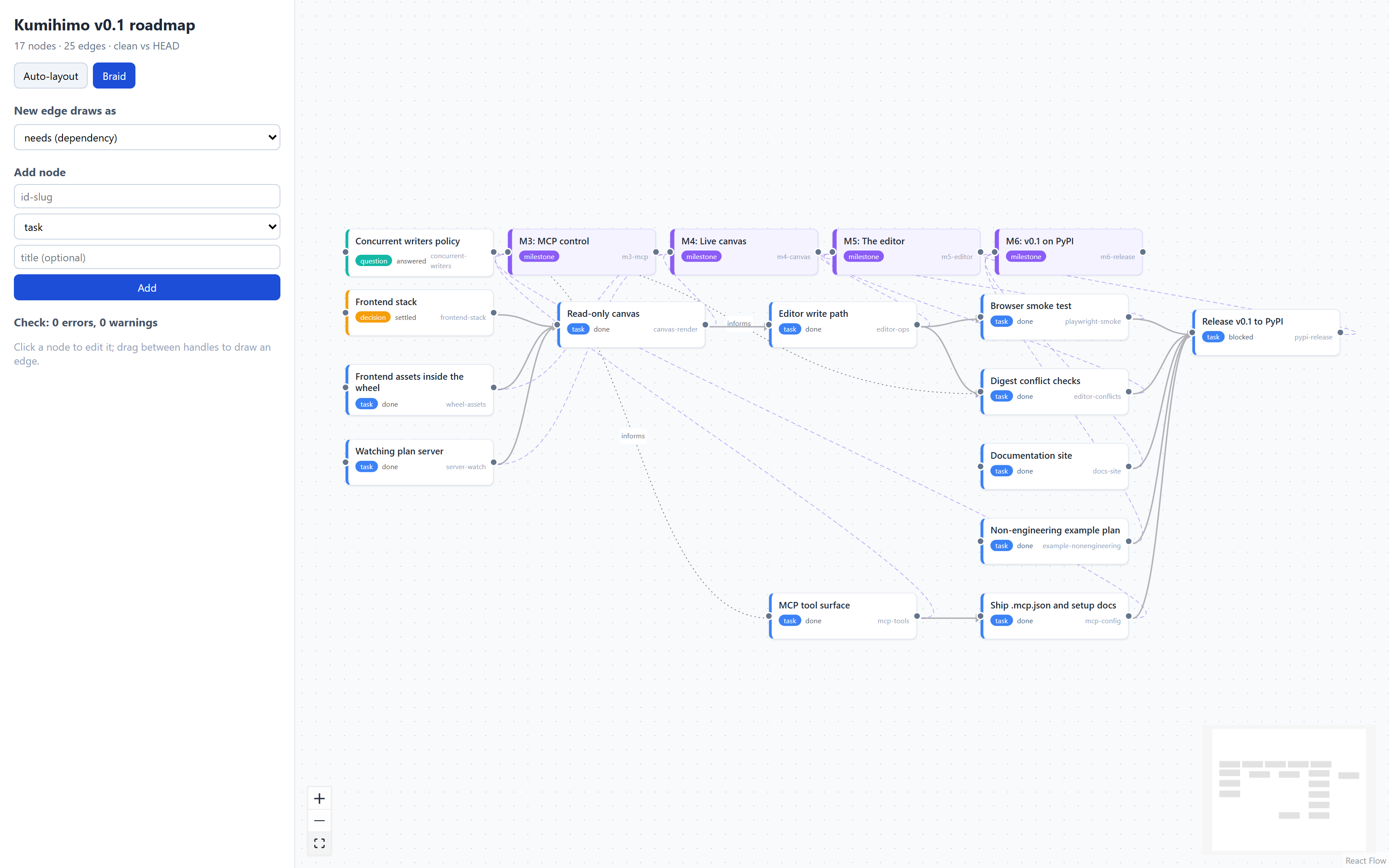
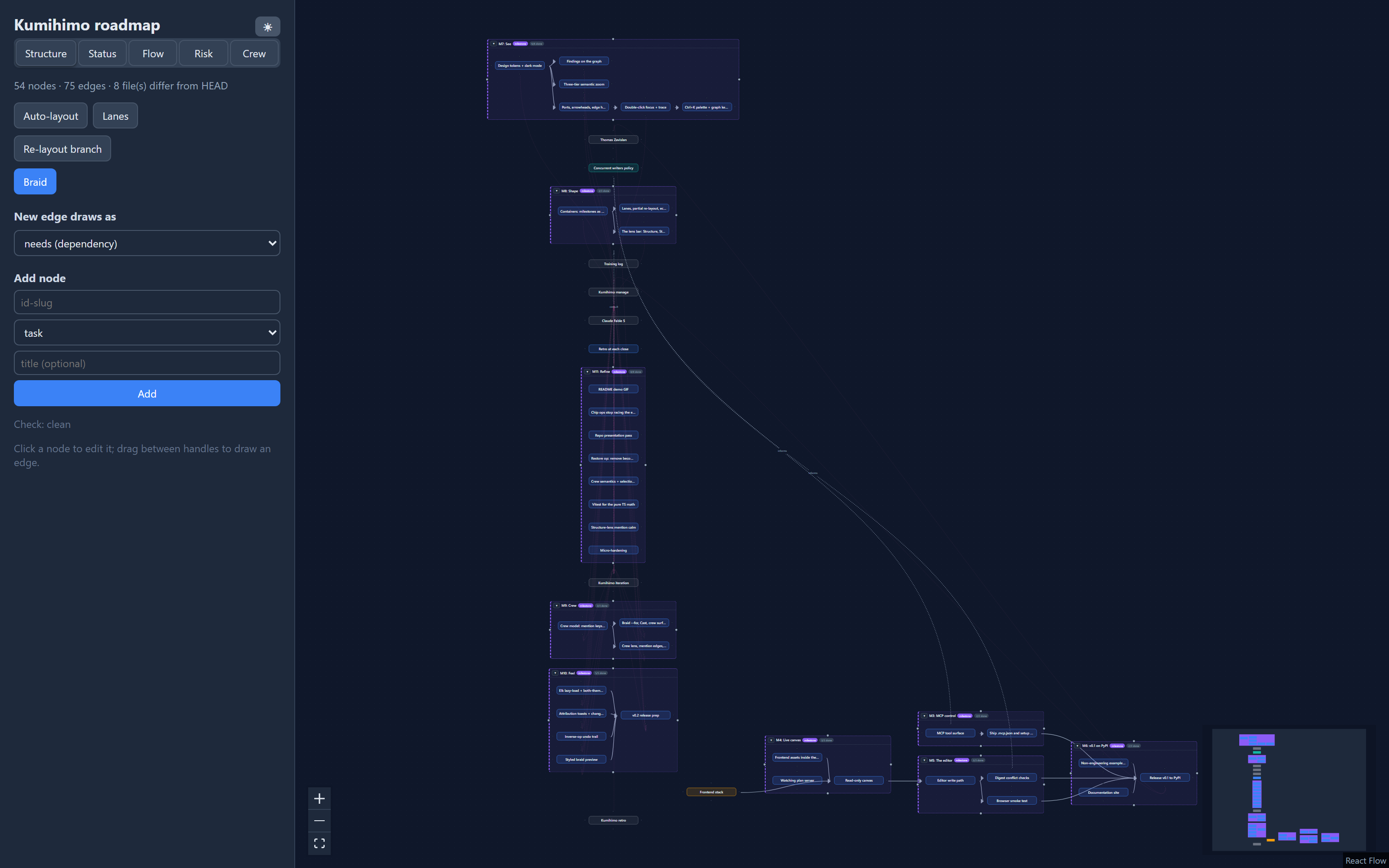
Here is that roadmap on the canvas today — v0.1 and v0.2 built end to
end, the crew on the canvas, and the release node still blocked on a
human with a tag: